
We know how to keep an eye on the price of a toaster to save a few euros. But when it comes to a flat costing a million, tracking the prices quoted over time can require a great deal more perseverance. It was this discrepancy that gave the three founders of Carissimo the idea of applying a familiar online shopping mechanism to the property market: keeping a record of the prices displayed.
Developed in their spare time, according to the team, the project is presented as an independent initiative and, at this stage, operates without its own commercial structure. Its creators prefer to remain anonymous. “Our current aim is, above all, to gauge interest in this service and gather user feedback in order to improve it,” they explain.
Price history analysis
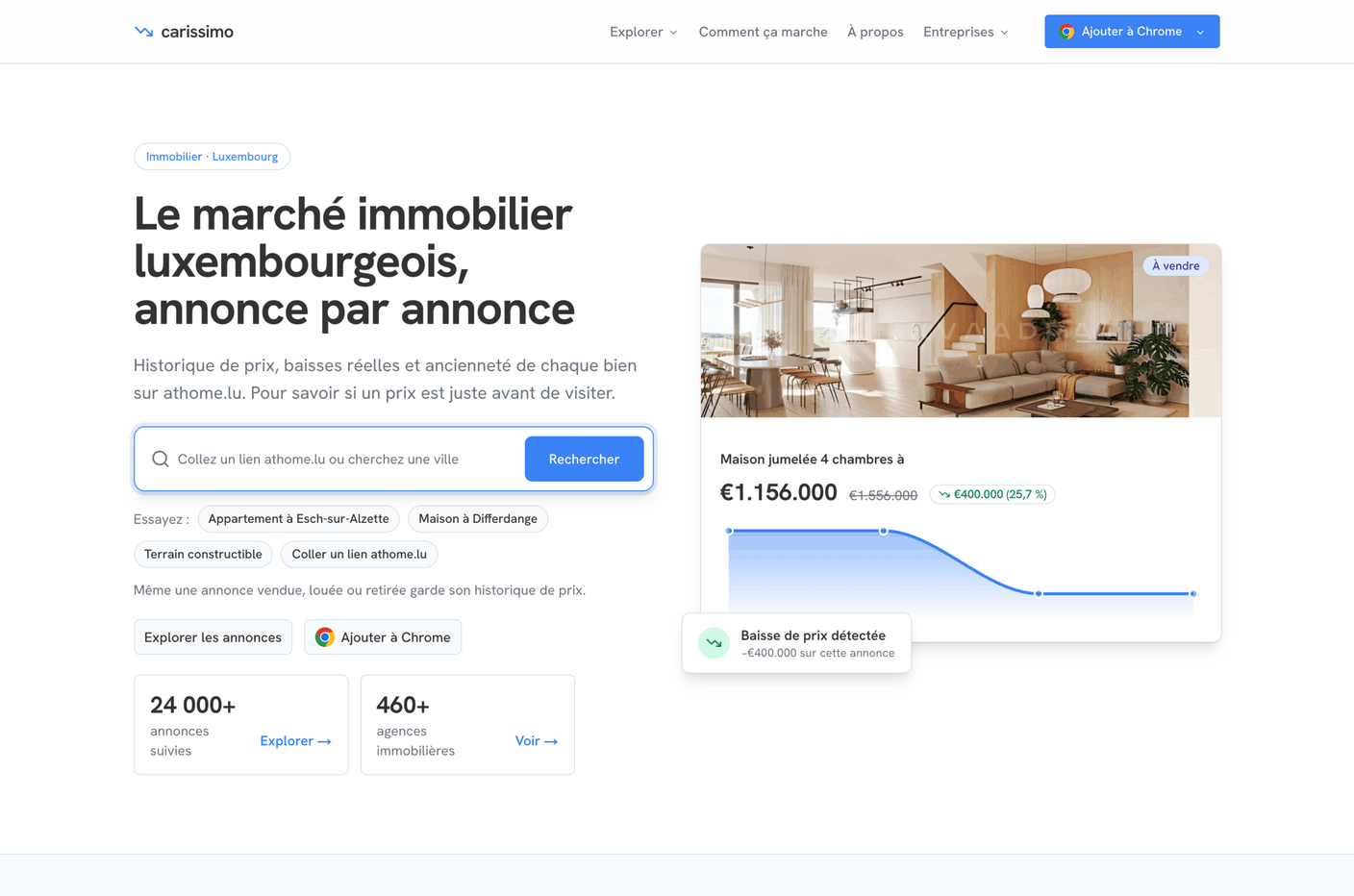
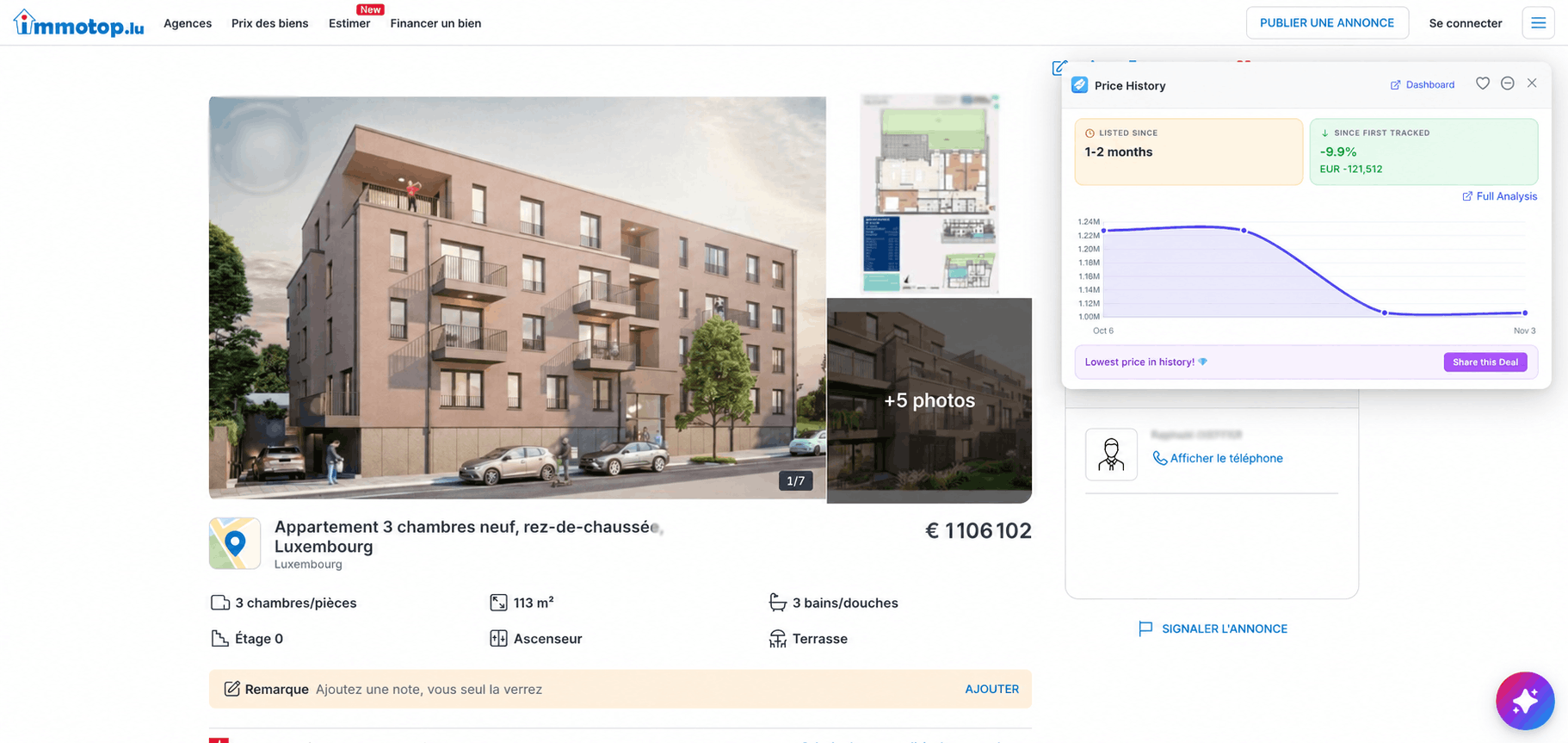
In Luxembourg, Carissimo allows users to view price changes in property listings. It should be noted that its Chrome extension currently works on atHome and Immotop.
But what else? Every change identified is recorded along with its date and amount, making it possible to track several successive reductions and their cumulative effect.
For a prospective buyer, this timeline complements the information provided in a property advert. A property whose asking price has been revised several times does not present itself in the same way as a property that has only recently come onto the market. However, it is still necessary to be able to find this information if you have not saved every advert since you began your search.
However, on a budget of one million euros, a 1 per cent variation amounts to 10,000 euros. That is reason enough to pay at least as much attention to the property’s history as to that of small household appliances.
Information asymmetry, you say?
The issue relates to what economists call ‘information asymmetry’: in a negotiation, not everyone has access to the same information. The seller and their estate agent are aware of the adjustments that have already been made; the buyer, who is viewing the property for the first time, is not necessarily aware of them. Making part of this process transparent can help them prepare their questions and put together an offer.
However, a previous price drop does not necessarily predict the next one. It may reflect an overly ambitious asking price, a repositioning in the face of competition, or a sudden desire to speed up the sale. But it is not enough to establish that the seller is in a hurry, nor to determine the remaining room for negotiation.
This information can also be useful from the other side of the table: a property owner who monitors price adjustments for comparable properties has additional information to help position their property amongst competing listings. Provided, of course, that the properties being compared are sufficiently similar in terms of location, floor area, condition and features.
Feedback that is also provided by users
The method deserves just as much attention as the curves and a few blind spots. Carissimo explains that the frequency of data collection depends, in particular, on the activity of its community: visits by users with the extension installed to property portals help to feed into the monitoring process.
Observations may therefore vary in frequency depending on the advertisements. The team acknowledges that it cannot guarantee that all price changes have been recorded. The history therefore shows the changes observed, whilst acknowledging that some may have been missed.
Another important feature is that Carissimo tracks each listing individually. If a property is republished as a new listing, both remain visible, each with its own history. The history of the same property can therefore be spread across several listings.
These limitations define the scope of the service: it is a source of supplementary information on the advertisements observed, but cannot, on its own, be relied upon to provide a comprehensive picture of the market.
“We are not a property portal,” the developers emphasise. Indeed, Carissimo is presented as a complementary tool: users are redirected to the original platforms to view the full listings. However, the service could also be of interest to estate agents wishing to keep track of listings and price adjustments in their area.
A few more maps
The initiative addresses a practical question: how can we help those viewing a property advert to gain a broader perspective? Keeping a record of asking prices can help with this, without necessarily determining the value of the property.
With regard to funding, Carissimo states that it is currently self-funded and describes its service as free of charge, ‘with no commissions or commercial partnerships influencing the presentation of results’. However, commercial development remains a possibility. The website also mentions possible commissions, the activation and application of which to the Luxembourg property market have yet to be clarified.
Above all, the initiative sheds further light on the asking prices. However, the price displayed does not reveal the price ultimately agreed, nor does the removal of a listing prove that a sale has taken place.
Carissimo aims to serve as an archive of published advertisements and contains additional and significant information for those who consult them. Thus, even though the current price remains that set by the seller, its price history gives the buyer a basis for negotiation.