You are a scientist, a technician, an environmentalist, a civil servant and a politician all at once… How would you describe yourself?

How would you assess your political career, particularly your time in government?
“I wish it had lasted a bit longer, as it takes nine months to a year just to find your feet. I already had the technical knowledge – covering issues such as environmental impact, the environment and its protection… I was less familiar with the field of international negotiations and, above all, the political game, particularly knowing how to handle attacks!
How do you learn to ‘build muscle’?
‘Let’s just say that, over time, you stop taking things so personally, even if the attacks are sometimes dishonest. As a scientist, dishonesty bothers me a great deal. I think it’s an irresponsible attitude when you’re committed to helping others, and even more so when you’re in a position of authority.
What is your frame of mind as you join the EIB?
“I am always guided by my values, and their strategic priorities are in line with these. What appealed to me was the chance to get back into European and international affairs. It is a very large organisation, with nearly 4,500 employees; I’ll need to find my feet. I want to help develop partnerships in the areas of climate and the environment, but also in the area of gender equality, which is a key issue for me. I am, in fact, a member of the relevant committee in the parliament.
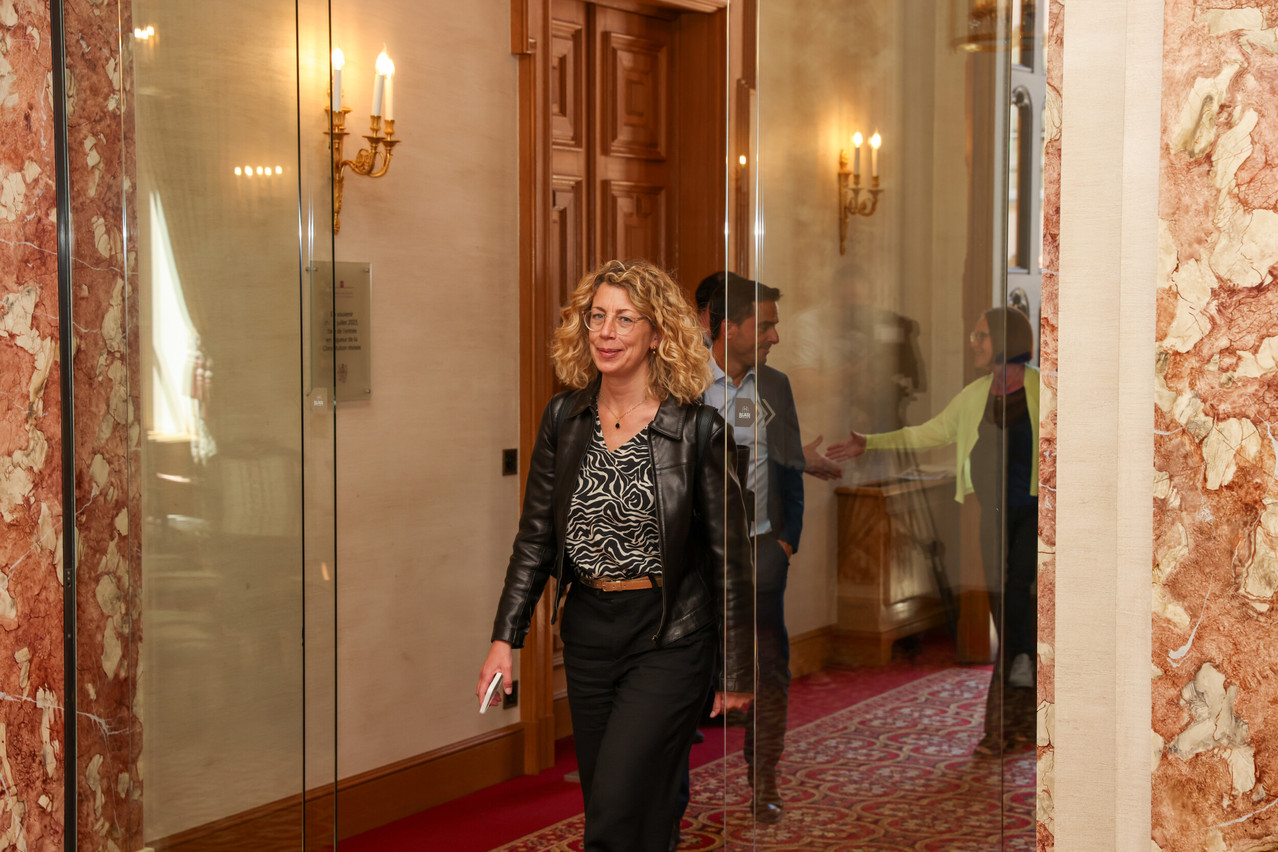
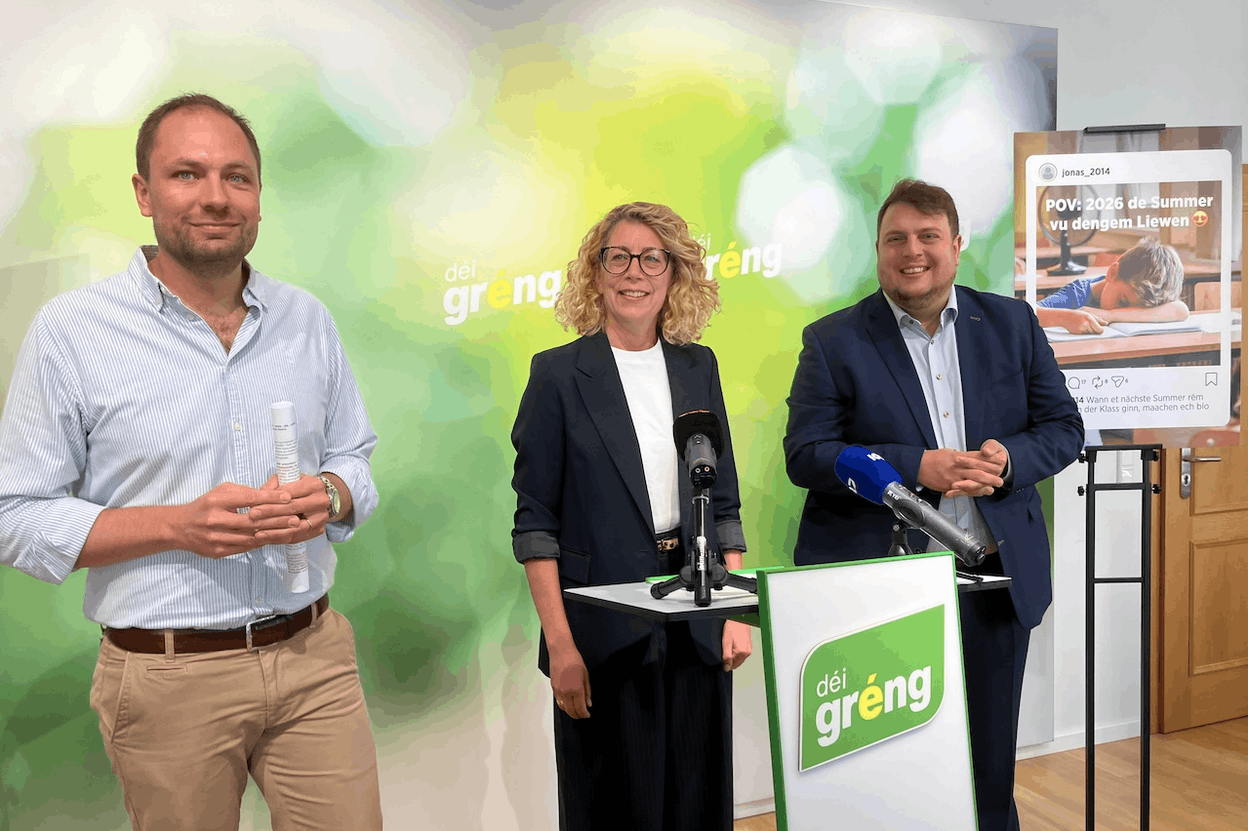
In October, Joëlle Welfring will join the EIB as a special adviser responsible for climate issues and initiatives relating to gender equality. She will therefore hand over her seat as a déi Gréng MP to Josée Lorsché. (Photo: Romain Gamba/archives)
Will you continue to be active within déi Gréng?
“In the near future – though not in my capacity as an elected representative, at any rate, as I believe that in certain roles we have a duty to maintain a degree of neutrality.
What does being an environmentalist mean to you?
“It is someone who cares for human beings, who ensures that we, who are here now, as well as future generations, can continue to live decently. The young people in school today will face increasingly extreme phenomena. Being an environmentalist, therefore, means treating the other living beings with whom we share this planet fairly. This implies a sense of justice and a commitment to equality, because, as we can see, those who suffer most from the heat are also the people with the fewest resources.
Why is it still difficult to convince people of the importance of the transition? Is it because of the way it’s framed?
“Yes, I think there’s some truth in that, but it’s also because people find it hard to change their habits. However, we can see that if we provide the infrastructure, a decent range of options and consistent rules, it sometimes becomes a matter of course. It’s not a question of ideology or fashion. Physics isn’t something you can negotiate with, but neither is it something that goes away if you ignore it. Generally speaking, we need to make things easier without scaling back our ambitions.
How can we reconcile economic and environmental concerns?
“One cannot function without the other. The 2006 Stern Review had already shown that a lack of sufficient investment in climate and environmental protection would result in damage whose costs would far exceed those of taking action. We are seeing this today. If we remain dependent on fossil fuels, we remain vulnerable. There are now limits to systems that were once economically promising.
What do you think of ‘degrowth’?
“That’s rather abstract. I’d rather talk about how we can set rules for ourselves. For example, is it right for a company to advertise cheap flights or non-recyclable coffee capsules? All of this is also an interesting lever. Because it encourages consumer legislation that also has an impact on health… I prefer to talk about economic development. In my view, it’s obvious that in a finite system or one that’s running out of steam, growth cannot continue exponentially. Common sense tells us that. But maintaining development at a stable level, with rules that promote the well-being of society whilst taking physical limits and resources into account, is, in my view, entirely feasible.
Is the incentive proposed by the government sufficient?
“Incentives have their limits: we also need rules. But these can only work if the framework and the alternatives are already in place, or easy to implement. The transition is imperfect, but we cannot wait for every solution to be perfect before we act. Electrification, for example, is not the answer to the fossil-fuel world, but an alternative. In nature, it’s all about balance… Electrification, for example, is not the answer to the fossil-fuel world: it is only part of the solution.
Is the country really as green as it claims to be?
“It certainly has some advantages, that’s clear. The previous government launched a whole programme of work, carried out in partnership with local authorities, to drive progress. But our interim report on greenhouse gas emissions, published in July, shows that challenges remain, particularly in the residential sector, due to heating systems. Overall, it is important to understand that whilst buying a new gas boiler is currently the cheapest option, gas will become increasingly expensive and will lock us into a dependency for another 15 years.
Isn’t the transition profitable enough to warrant further investment?
“It depends on the timescale and political choices. In the very short term, perhaps not. But the world around us shows that the very short term has its limits. On the contrary, businesses that depend more directly on the functioning of nature are very keen to put rules in place and move forward.”
This article was written for the October 2026 issue of Paperjam magazine, published on 16 September. The content is produced exclusively for the magazine. It is published on the site to contribute to Paperjam’s comprehensive archive. Click on this link to subscribe to the magazine.
Is your company a member of the Paperjam Club? You can request a subscription in your name. Please let us know via [email protected].