US financial markets are undergoing a structural transformation, with the growth of derivatives reshaping trading and portfolio management. More frequent option expirations—including zero days to expiration (0DTE) contracts—longer trading hours and increasingly sophisticated hedging tools are expanding the ways investors can manage risk.
In this conversation held on 3 November 2026, Michel Bourgon, senior equity portfolio manager at DPAM, discussed these changes ahead of Cboe Global Markets’ planned rollout of new S&P 500 options settled based on opening prices. Starting on 9 November 2026, these new expirations will complement the existing close-settled expirations.
Bourgon explains how derivatives give active portfolio managers a precision toolkit akin to fine watchmaking. He also examines the regulatory and cultural differences that, he argues, leave European markets trailing their US counterparts.
Does this expansion of derivative products and trading windows risk fragmenting or diminishing market liquidity?
Michel Bourgon. - “Cash equity trading volumes on US stock markets have stagnated or slightly declined, particularly since the 2008 financial crisis. In contrast, the broader derivatives market—encompassing both futures and options—has grown exponentially.
Thirty years ago, derivatives accounted for roughly 5% of traded market volume; today, they represent 70% to 80%. Cash equity liquidity itself remains sound, but overall market liquidity has undeniably migrated towards derivative instruments.
Regarding extended trading hours, I view it much like Amazon: investors gain the freedom to execute decisions whenever they choose without waiting for traditional market opening hours. Broader trading windows tend to lower transaction costs, though, because lower bid-ask because market liquidity becomes continuous and more efficient.
At its core, the options market functions as an insurance market—paying an option premium is conceptually identical to paying an insurance premium to hedge underlying risk.
You describe these market developments as a "financial revolution". Could this expansion of derivative instruments help revitalise active asset management?
“Absolutely. For traditional active portfolio managers, derivatives represent a major opportunity to differentiate their strategies from passive ETFs. Beyond standard stock picking, active managers can utilise options to construct tailored risk-reward profiles aligned with specific client mandates.
Our derivative-based investment offering serves as a core differentiator, and several institutional investors specifically select us because of our capability in derivatives.
Have you observed empirical data over 10 years showing whether funds that actively use derivatives achieve superior performance over funds that do not?
“Many active managers still refrain from using derivatives, often due to investor apprehension or a lack of familiarity regarding option mechanics.
Because the massive surge in derivative activity is relatively recent—accelerating predominantly post-Covid—a full 10-year track record reflecting current market structures is still taking shape. As access costs continue to fall, derivative adoption across active management will steadily expand.
How do long-term growth trends break down visually across various derivatives?
“Looking at multi-year trends, US cash S&P 500 volumes have drifted slightly downward since the dot-com era (chart 1: middle panel). Futures volumes surged during the dot-com boom but have remained fairly stable post-2008 financial crisis (chart 1: bottom panel).
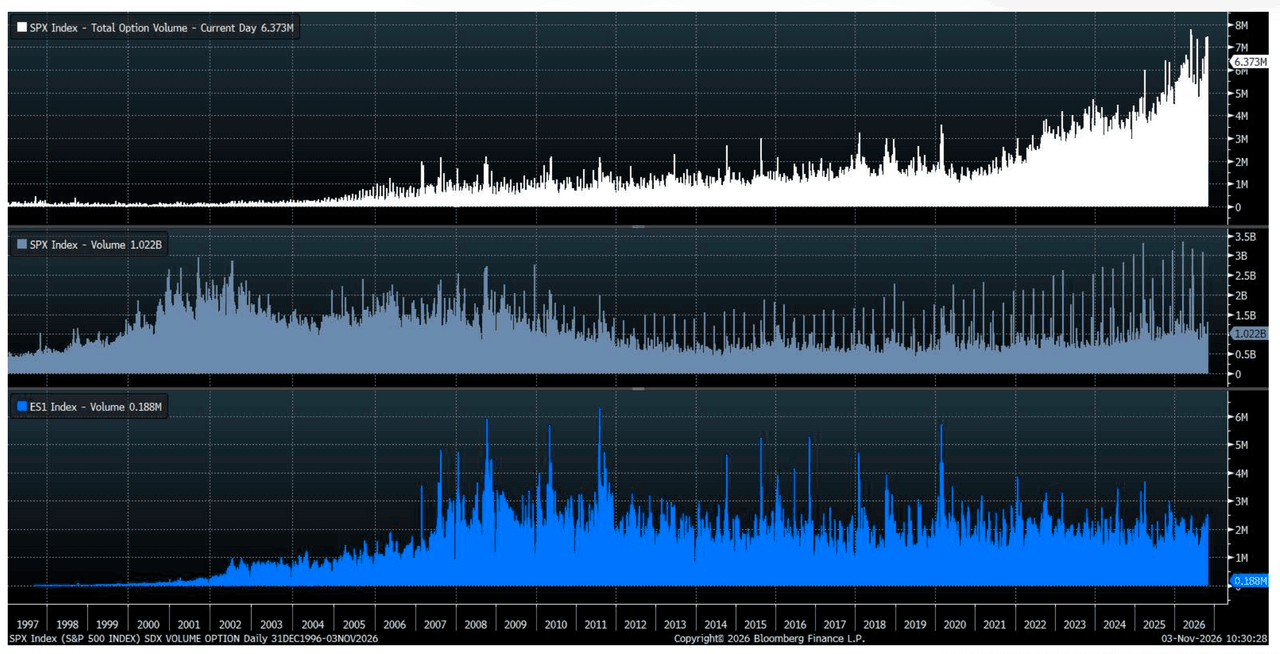
Chart 1: S&P 500: Volume on option, cash and future markets Source: DPAM
The explosive growth is entirely concentrated in option markets (chart 1: top panel), where volumes have roughly quadrupled since the Covid period. Shorter expiration cycles (such as 0DTE options) naturally multiply turnover, as investors frequently roll over short-dated positions. S&P 500 0DTE options alone now average 2.3m contracts per day, representing 59% of total option trading.
Is the emergence of ultra-short-dated options contributing to the gamblification of capital?
“While speculative gambling exists, it remains the exception and more a retail phenomenon. The primary driver of derivative markets is risk mitigation. Institutional derivative trading is strictly regulated and governed by sophisticated risk models, making unmanaged gambling virtually non-existent in that segment.
In the US, approximately 4% of retail investors maintain active derivative accounts (compared to just 0.5% in Europe). On 0DTE options specifically, retail accounts represent nearly 50% of total trading volume.
However, retail participants predominantly execute income-generating, risk-defined strategies—such as iron condors, call spreads, put spreads, and butterflies—to capture implicit volatility with capped downside.
Because US brokers enforce strict margin risk limits, systemic gambling risks remain constrained.
How do option transactions directly influence price action in the underlying cash equity market?
“Historically, option expirations were concentrated on specific quarterly dates when stock index futures, stock index options and individual stock options expired simultaneously—an event known as “triple-witching". These dates often coincided with sharp spikes in volatility or market turning points.
Today, daily 0DTE expirations—which process roughly $1.2trn in daily S&P expiration value compared to $4.0trn on quarterly triple-witching dates—have significantly smoothed out market volatility.
Rather than a single massive monthly volatility shock, 0DTE options create minor daily gamma (volatility) peaks near market close (22:00 European time), compressing overall volatility, according to central bank studies. Because market makers are generally long gamma, their dynamic hedging activity stabilises market fluctuations.
The options market is essentially an insurance market. The more precisely you can hedge your risks, the more stable the environment becomes. Insurance is fundamentally a stabilising force, rather than a destabilising one.
Furthermore, US exchanges are proposing a second daily expiration at the US market open (15:30 European time). Because key US macroeconomic data releases occur between 14:30 and 16:00 European time, opening expirations will allow market participants to hedge macro events at a lower cost due to reduced option time value.
Equity markets have been in a sustained bull run since 2022, and bull markets naturally exhibit lower volatility. Isn't it premature to attribute reduced volatility permanently to 0DTE options (see chart 2)?
“Academic studies acknowledge the difficulty of isolating counterfactuals in real-time markets. However, financial markets have displayed remarkable resilience against major geopolitical shocks—such as the war in Ukraine or tensions involving Iran—with unexpectedly modest price corrections. This stability is largely supported by widespread, precise hedging across crude oil, currencies, and equity indices.

Chart 2: Daily options have contributed to a reduction of S&P 500 volatility Source: DPAM
Turning to Europe, your paper notes that Russell 2000 futures trade eight times the daily volume of the entire French CAC 40 index. What explains this vast disparity in derivative market activity?
“US investors have a deeply rooted equity culture supported by funded pension systems, leading to far higher retail and institutional market participation. In proportion, 4% of Americans hold derivative trading accounts compared to 0.5% of Europeans—an 8x difference.
Secondly, 80% of US small-cap equities in the Russell 2000 have listed options available, whereas only 15% to 20% of European small and mid-cap stocks have listed options. Small caps carry higher single-stock risks (such as single-product or single-client concentration), making option hedging particularly valuable.
Furthermore, the US market benefits from a highly active ecosystem involving pension funds, hedge funds, market makers, and retail investors. Retail investors account for nearly 50% of 0DTE volume in the US, whereas retail represents only 5% to 10% of Euro Stoxx 50 0DTE volume in Europe.
How do European regulatory frameworks, such as MiFID II, impact derivative trading relative to the US?
“Regulations create distinct structural barriers. In the US, platforms like Robinhood offer zero-commission derivative trading via Payment for Order Flow (PFOF), selling trade flows to market makers such as Citadel or Sigma.
In Europe, PFOF is banned under MiFID II to ensure complete fee transparency. While European investors receive explicit fee disclosures, order flow and liquidity gravitate towards US venues.
Additionally, MiFID II enforces strict appropriateness tests before retail clients can trade derivatives, whereas US regulatory frameworks are significantly more permissive. Consequently, European institutions and retail traders frequently route orders directly to US exchanges to access superior liquidity and tighter bid-ask spreads.
What is your overarching outlook on the future of derivative instruments?
“Modern derivatives are comparable to high-end fine watchmaking (“haute horlogerie”). They provide portfolio managers and investors with high precision to customise risk management strategies at minimal cost. As products and trading windows expand, this ecosystem offers an efficient foundation for modern asset management.”