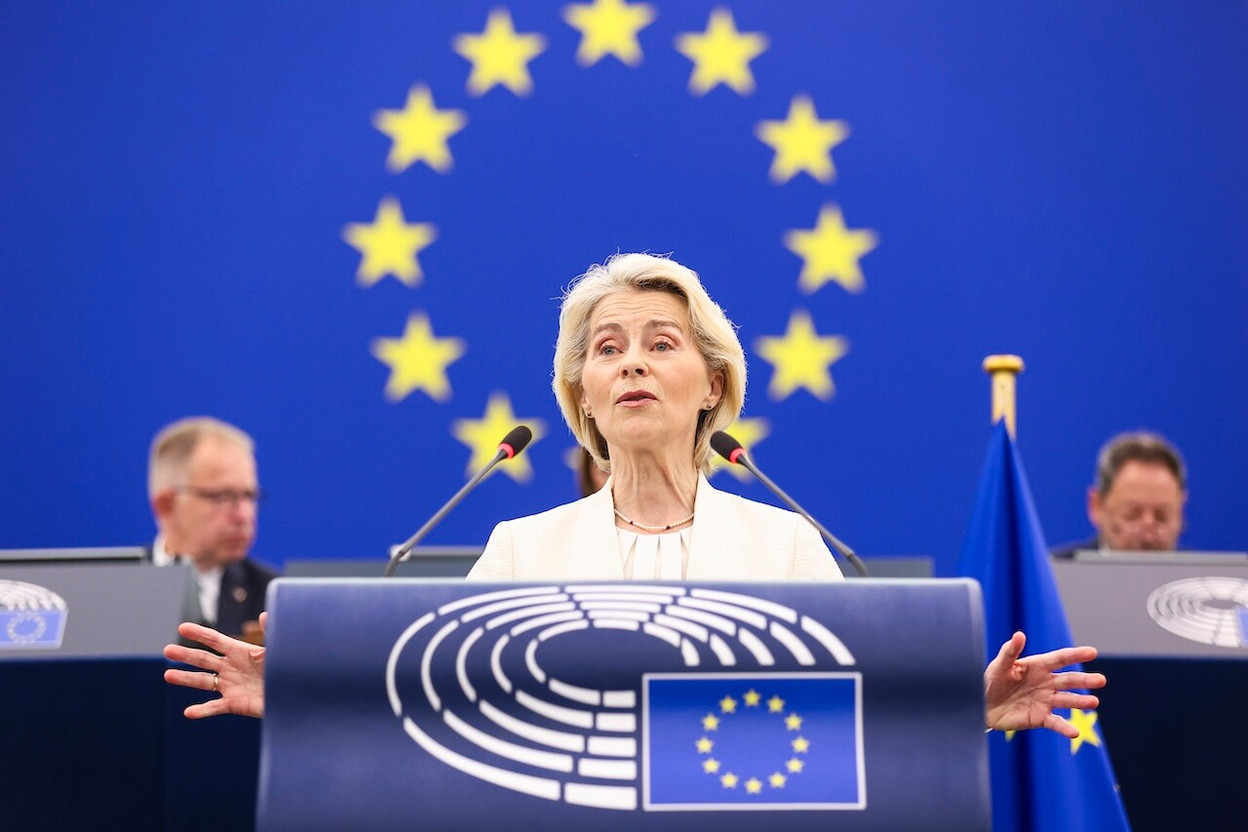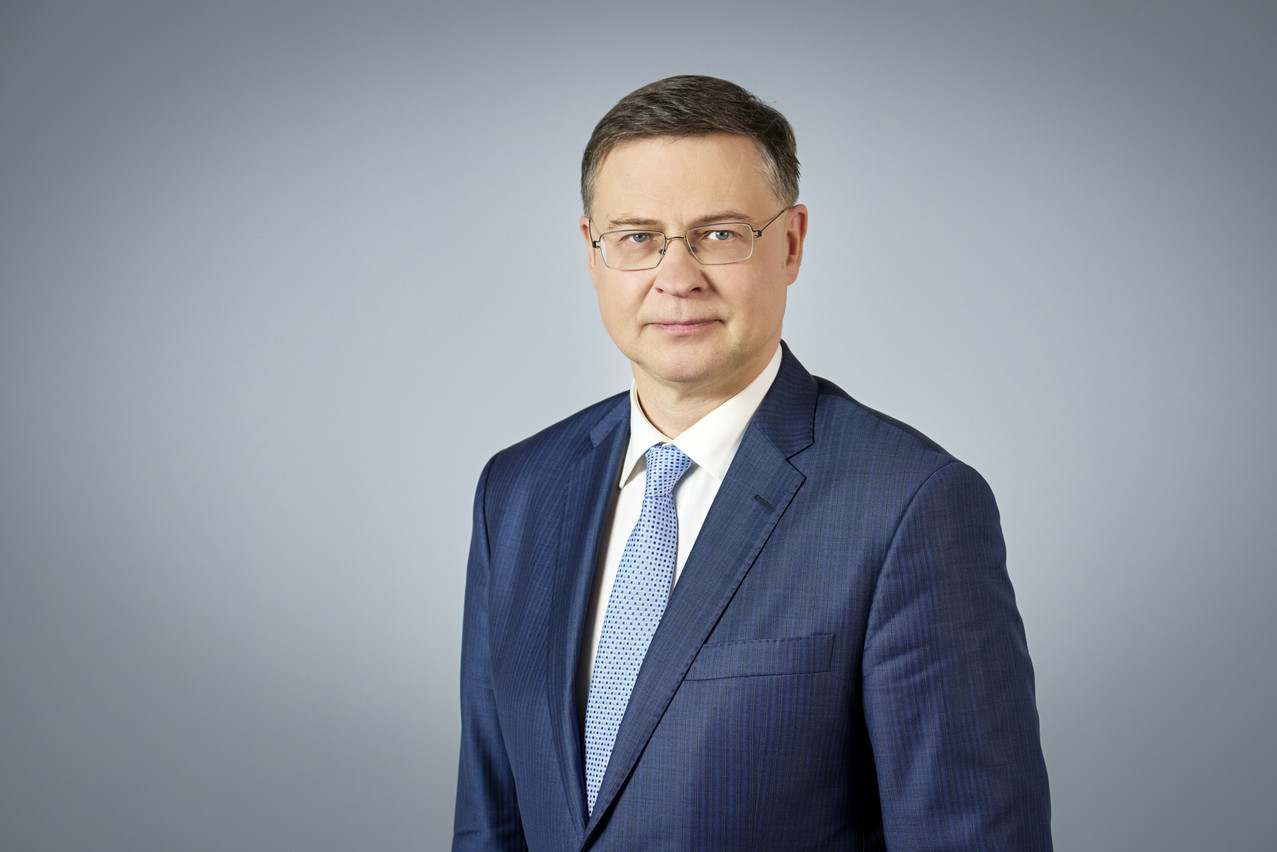
Valdis Dombrovskis is the European Commissioner for the Economy and Productivity, as well as for Implementation and Simplification within the European Commission. He led the Latvian government as Prime Minister from 2009 to 2014, during which time he oversaw the management of the financial crisis in his country.
Whilst on a working visit to Luxembourg to meet with economic stakeholders and business representatives, he answered questions from Paperjam about his simplification agenda and the EU’s economic and budgetary governance.
Competitiveness is a priority for your Commission. What concrete results can you present to businesses?
Valdis Dombrovskis. – “We have set two main priorities: strengthening the competitiveness of the European economy, and enhancing our security and defence. For at least two decades, productivity growth in Europe has lagged behind that of other major economies. We must address this. The ‘Competitiveness Compass’, presented at the start of this term of office, identifies the main challenges and the ways to address them. We have already put forward around 50 proposals concerning innovation, skills, energy prices, barriers to the single market and administrative burdens.
On this final aspect, for which I am responsible, we are aiming for a 25% reduction in administrative burdens – and 35% for SMEs – by the end of this term of office. This would represent annual savings of €37.5bn. The twelve Omnibus proposals and the other simplification initiatives put forward would already yield savings of around €17bn a year, provided they are adopted without any scaling back of their ambition. We have made a good start, but we must maintain the momentum.
What are the expectations of the Luxembourg-based companies you met?
“They are asking us to continue simplifying procedures and to ensure that the results are visible on the ground. They feel that these efforts are not yet sufficiently evident in their day-to-day operations. Some of the obligations we have eased had not yet come into force. We have therefore simplified regulations that would have made life much more complicated for businesses. But avoiding an additional burden is not necessarily perceived as simplification.
Furthermore, several Omnibus bills are still undergoing legislative scrutiny. Businesses will only feel the effects of these once they have been adopted, provided that legislators maintain their ambition. What matters to them is not what the Commission is proposing, but what emerges from the legislative process.
Where do you draw the line between simplification and deregulation?
“This is a subject of heated debate. We are not compromising on our high social or environmental standards. We are seeking to achieve the same objectives with fewer administrative burdens and at a lower cost. The Green Deal’s objectives remain unchanged, notably climate neutrality by 2050 and our targets for 2030. The question is how to achieve them more effectively.
Trade organisations, both European and national, are calling on us, above all, to continue with the process of simplification.

Changing a rule also imposes new costs on businesses that have complied with it. How do you take this regulatory instability into account?
“That is a valid point, which we are discussing with businesses. However, trade organisations, both at European and national level, are asking us, above all, to continue with simplification. They believe that the administrative burden remains significant and continues to grow. Luxembourg businesses have again today cited surveys that support this view.
It would, of course, have been preferable to draw up rules that were sufficiently simple from the outset, rather than making them more complex only to have to simplify them later. Unfortunately, this has not been the case for a number of pieces of legislation. Regulations have also accumulated over the years, creating inconsistencies and overlaps. We must learn from this. We have presented a communication on clearer, faster and better-enforced European regulation. We want to build simplicity into the design of legislation from the outset and take full account of its impact on competitiveness.
In the context of Europe’s economic slowdown, how much weight would you give to regulation, compared with under-investment, energy prices or market fragmentation?
“We cannot quantify the contribution of each of these factors separately. They are all included in our competitiveness compass. We look at the problem as a whole and seek to address each of them. We have set a target for reducing administrative burdens, but this is obviously not the only issue. Barriers to the single market, energy prices and other factors must also be addressed.
Doesn’t an industrial policy based on state aid favour those countries that are able to spend the most?
“This is a genuine concern. Our competition rules are specifically designed to ensure a level playing field within the single market. We are reassessing this balance to some extent to also take into account the ability of European companies to compete internationally, particularly against the industrial giants of other major economies. But we must preserve fairness within the single market.
We have put forward several initiatives, including the Industrial Accelerator Act. The next multiannual financial framework also places greater emphasis on these issues, notably through the Competitiveness Fund, which is designed to support innovative and strategic industries. Competition rules and state aid rules remain essential.
The single market for financial services is crucial for Luxembourg. Why is it taking so long to complete?
“Since the global financial crisis, we have, in fact, seen a renationalisation of the provision of financial services. Numerous pieces of legislation have been enacted to ensure financial stability. This framework has served us well during recent crises: the sector has withstood shocks and continued to finance the economy. It is now part of the solution. We must therefore preserve the prudential framework, whilst working to simplify it. At the same time, we need to identify the barriers to cross-border activities, particularly in supervisory practices and prudential requirements. This is one of the key areas of focus in the action plan for the Savings and Investment Union.
We must maintain the prudential framework, whilst working to simplify it.

What role can the Stock Exchange play in bringing together savings and investment?
“Financing the economy is a key factor in competitiveness. Europe has around 11,000 bn euros in household savings, most of which remains in bank accounts. We want to channel more of this into financing the European economy.
Luxembourg has a role to play, particularly as a centre for insurance and asset management. Its financial sector emphasises the importance of removing barriers to the cross-border provision of financial services. Its experience can help us to identify these barriers and overcome them.
How can we fund defence, the energy transition, an ageing population and competitiveness whilst keeping debt under control?
“It is no easy task, but it is what we must do. We have revised the European framework for economic and fiscal governance to strengthen its medium-term perspective and give Member States greater flexibility in defining their trajectories, whilst ensuring debt sustainability. Rising interest rates and the markets’ reassessment of sovereign debt, particularly at the long end, are complicating the situation. This requires us to set priorities and to focus on the quality and composition of public finances.
As regards defence, we have allowed for additional flexibility between 2025 and 2028. Member States must use these four years to adapt their budgets to expenditure that will remain structurally higher. The world is becoming a more conflict-ridden and dangerous place. We must invest in our security, and this flexibility allows us to make the necessary adjustments gradually.
Can this flexibility be extended to energy, competitiveness or an ageing population?
“We have recently proposed additional flexibility in response to the energy price shock. This is not about subsidising fossil fuels: you cannot resolve a supply shock by stimulating demand.
The aim is to reduce our dependence on imported fossil fuels more quickly, in particular by improving energy efficiency and adapting the grids to more decentralised generation. So far, Italy and Greece have requested to benefit from this flexibility.
More broadly, we must reconcile the challenges we face with debt sustainability. National circumstances vary greatly. Luxembourg has stable public finances, a budget that is broadly in balance and a low debt-to-GDP ratio. Other countries have significant deficits and high, rising levels of debt. Their room for manoeuvre is much more limited.
Could the European Union borrow more to support Member States?
“It is already doing so in a number of areas. NextGenerationEU was set up to address the consequences of the pandemic, and was subsequently bolstered by REPowerEU in response to the energy crisis triggered by Russia’s invasion of Ukraine. We are also using joint borrowing for the SAFE programme, which supports defence capabilities and industry, as well as for the loan to support Ukraine. In our proposal for the next multiannual financial framework, starting in 2028, we also envisage the possibility of using joint borrowing as a crisis response mechanism.
Can it be turned into a sustainable means of financing strategic investments?
“This is a very complex discussion amongst the Member States. Several of them have only accepted NextGenerationEU as an exceptional measure, not intended to become permanent. We therefore view joint borrowing more as a response to crises than as a permanent structural mechanism.”