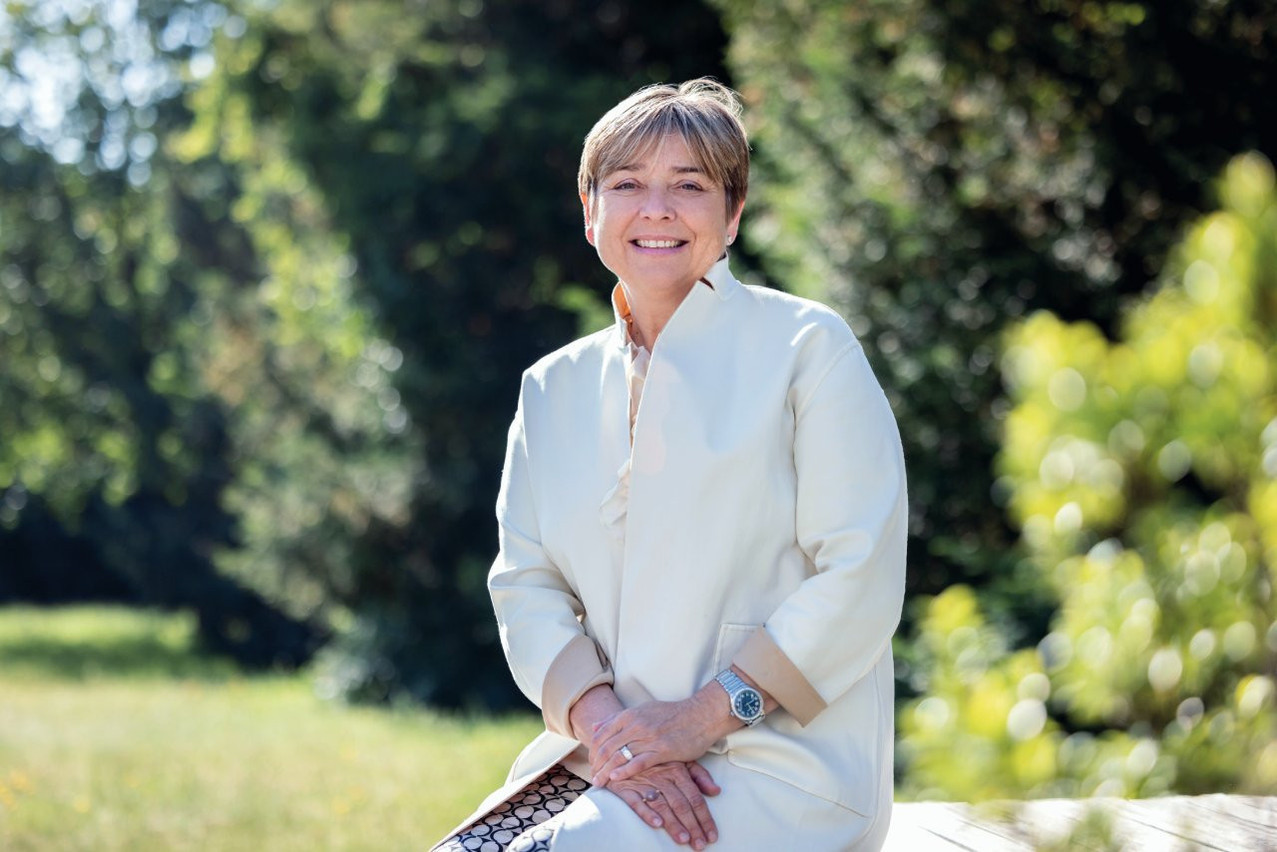
It is doubtful that she would have agreed to this interview a few years ago. 
On the morning of our meeting, she was smiling despite the low sky stretching out behind the bay windows of the meeting room. The weather was gloomy, but she preferred to ignore it: ‘I've learned to love the things I can't change,’ she whispered to us, before telling us that she had taken the time, before coming to work, to take her dog for a walk in the forest when she woke up. A little bit of happiness gleaned from her day. The kind she cultivates with the same seriousness she displays in business. Her life balance.
Your very first contact with the world of work? Your first memory?
Manou Hoss. – "Apart from babysitting my two little sisters and my many cousins, it was the switchboard operator job at this research centre. A summer job, when I was 15 or 16. Outside of the research centre, I then had an experience working in a bookshop. I love reading and being around books. Books have a unique smell... I was in my twenties, and again it was a summer job, for a month. As for my first professional experience in the legal world, that was in New York. I spent six weeks at the Republic National Bank of New York, in the legal department. A woman ran that department. She made a big impression on me, showing me in the 1980s and 1990s that a career in law was possible for a woman. Things were not the same then as they are today.
It was the independence of the legal profession that appealed to me, much to my mother's dismay.

At the age of 15 or 16, was the path to law already mapped out in your mind?
"Not at all. I never considered studying law. I come from a family with many lawyers. Not only in my generation, but also in the previous generation: both my grandfathers and my parents studied law. Having passed her exams with the highest honours, my mother was forced to give up her career due to a lack of childcare. She regretted this. However, she never told her four children to follow in her footsteps so that they could achieve what she herself had not been able to achieve. On the contrary, she told her daughters: 'Do something else, the hours in this profession are too hard for a woman.'
In your early youth, what subjects attracted you?
"I loved languages, especially French and English. So I considered either studying English to become a teacher or pursuing a career in science. In the end, I made up my mind by taking a stand “against”. Against the prospect of being a teacher, because I didn't want to spend my whole life at school. And against the prospect of science, because I valued my independence. It was the independence of the legal profession that appealed to me, much to my mother's dismay. She tried everything she could to change my mind, just as she had tried to do with my two sisters. In the end, all of us siblings studied law (smile).
Even when I was studying law, I didn't necessarily want to become a solicitor. I thought, “Law leads to everything, as long as you get out of it.” That's true today: while I'm still in the profession, I've moved away from it somewhat, as I've been managing the firm for over 20 years.
Someone who is not independent inevitably finds themselves in a situation where they lose some of their freedom. That's what I wanted to avoid at all costs.

Throughout your career, have you ever been tempted to make a radical change of direction?
"In the first ten years of my career, I thought about it at least once a day. In particular, I thought about returning to teaching.
Why did you ultimately decide to stay?
"Simply because I enjoy the job. We work in a very stimulating environment. For example, I really enjoy being surrounded by young people. It's extremely rewarding and invigorating, and it gives you a different perspective on the world. It teaches us a lot about society and about ourselves. The joy of learning is essential in my eyes.
What was the turning point that led to you and I chatting here today?
"I had four children, which brought me immense joy. Shortly before my youngest daughter turned three, I took six months off to reflect. I thought about what I wanted to do and considered various options: going into teaching, opening a bookshop... Despite everything, the desire to remain independent, both in my career and in my personal life, remained strong in my mind. It was essential for me, and it still is today. Someone who is not independent inevitably finds themselves in a situation where they lose some of their freedom. That's something I didn't want at any cost.
And then, I couldn't see myself leaving this wonderful adventure that is studying. There were so many great things that could be done... When I returned after this six-month break, I suggested taking on more of these projects that could be undertaken alongside my legal work, and possibly outside of it. It's now my full-time job.
What early career mistake would you rather not have made?
"I would make all the same decisions again regarding my career. In fact, I would only change one thing. At the very beginning of my career, I wasn't working full-time. And in the business world, I felt that this was not something you could say. In 1991, I felt that it was not accepted. As a result, instead of letting others know that I was dividing my time between my job and my family, the instruction was to answer the phone with, “She's out on a meeting, she'll call you back.” That shows how conditioned we were at the time – me, at least.
Today, I pick up my granddaughters from nursery twice a week, and I say it loud and proud. There's no need to hide it, it's something that's rewarding... and should be valued.
I was much more impulsive 35 years ago than I am today. That's another advantage of getting older.

In your decision-making, what temperament do you claim to have?
"When it comes to small, everyday decisions that affect me personally, I act very quickly. That's because I don't like wasting time and I know myself well. On the other hand, when it comes to big decisions that affect others, I try not to take a position straight away if I don't have a good grasp of the subject. I love these maxims, which I often quote: “Hasten slowly” and “Sleep on it”. I was much more impulsive 35 years ago than I am today. That's also one of the advantages of age (smile).
How do you manage to overcome difficult times?
Ms Lagarde once said of Ms Von der Leyen: ‘Commitment, conviction and courage.’ That is what I apply in difficult situations. Difficult times are when you find out whether you have a safety net or not. What I am most proud of is definitely my safety net: it supports me and pushes me forward. It's a bit like a trampoline, actually.
What do you mean by “safety net”?
"I was born into a large family. My parents meant a great deal to me. They were extraordinary people, independent, cultured, humane – in the humanistic sense. I have wonderful siblings. I have a partner “in office” and “in life” who is my best advisor, and therefore my greatest mentor. I have four children, and I learn a great deal from them. It is often said that we learn a lot from our parents, but I think we learn just as much from our children, about ourselves. And I have a circle of extraordinary friends and associates.
Volunteering has shown me resilience in other people, and helped me build my own.

Apart from your family, which mentors have been particularly important in your career?
"I was very fortunate to be involved in volunteering from a very young age. Volunteering brings you so much: you give, but in return you gain human connections that you would never have had otherwise. These little connections that are forged are also a lifeline. Seeing very different situations, people's lives that are much more difficult than ours, in a law firm, helps you to take a step back.
I was active in the local Red Cross branch from a very young age, and became more involved between the ages of 25 and 30. This led me to become president of the local branch in 2018. Since then, I have also been a member of the Red Cross board of directors, where I currently serve as vice-president. Volunteering has shown me resilience in other people and helped me build my own.
Actually, I don't have ‘one’ mentor. I have a network of connections in various places, in contact with different generations. Obviously, I learned a lot from my parents. I mentioned my mother earlier. Women of my mother's age—and I would mention Colette Flesch (former Olympic fencer, first female mayor of Luxembourg, and first female deputy prime minister in 1980, ed.)—have had extraordinary careers that inspired in me the desire and vocation to show what women are capable of.
Besides your “safety net,” what professional achievement are you most proud of?
"I haven't achieved anything on my own. The only thing I decided on my own was to remain a lawyer. It's a profession that contributes to democracy and, in that sense, is an essential link in our fundamental freedoms. It makes me proud to have remained a lawyer.
I am also proud to have participated in the collective and collaborative development of a firm that began before me, will continue after me, and is recognized for its expertise and commitment beyond the law.
Finally, I am proud to have contributed—on a small scale, of course, but every link counts—to making the Luxembourg Red Cross a key player of high quality, through its actions and its members, which today employs more than 3,000 people. I have always set aside part of my working time, officially with my associates, for this voluntary commitment, which is an integral part of my career.
That's my triptych: family, studies, and volunteer work.
Was there a moment when you said to yourself, “That's it, I've made it”?
"To keep up with and accomplish everything I do in a day, I try to have good moments every day. I manage to do that most of the time. Even in difficult times, if you have one or two good moments, you've had a successful day.
Beyond that, what is success? For me, it's being able to do a job that gives me independence and maintain strong ties with my family. And being able to read a book from time to time!
The last novel you read?
“Tant mieux” by Amélie Nothomb. Read in Paris in one day.
I had progressed far enough in my career to understand that fundamental change in gender equality would only come about if women became visible.

What piece of advice has inspired you the most since you started out?
“Maybe not advice, but the idea of always asking ‘why?’ In everything we do. Why wouldn't we do it this way? Why do we do it? Why don't we do it? Always question things. Think outside the box. A credo: ‘Think outside the box.’”
Otherwise, it wasn't really advice I received, but when I decided to focus more on the firm's internal activities, I took a course in mediation. The emphasis was on active listening, attentive listening, understanding what drives the other person, what their motivations are. Motivations are extremely interesting in conflict resolution as well as in everyday life.
What is the hardest criticism you have ever had to hear?
“One day, a long time ago, someone said to me, ‘Have you thought about it?’ The next day, I went back to see that same person to remind them that just because I didn't share their point of view didn't mean that I hadn't thought about it...”
What is the most important thing your career has taught you about yourself?
"That I am capable of listening and not talking. I love talking; it's an integral part of being a lawyer. Confronting, challenging. With two parents who are lawyers, an older brother, and two younger sisters, discussions come naturally to me. But I've learned that I learn more when I talk less, because it allows me to listen more.
What would the young woman you once were think of the woman you are now?
"She wouldn't imagine that. Take, for example, the interview we're doing right now. It's a conscious decision on my part, but it was never my goal to be in the media or appear in photos. I wasn't interested in that.
I was already in my current position when our firm, which had been very discreet for a long time, decided to become more visible. At that time, there was a road safety campaign telling cyclists and pedestrians to “become visible.” For my part, I had progressed far enough in my career to understand that fundamental change in gender parity would only come about if women became visible. So I decided to become visible. I could have decided to do so earlier, but I think it served me well not to always be visible. Visibility has to be carefully measured.
If you could relive a moment, what would it be?
There are too many!
If your career were a book, a movie, or a song, what would its title be?
“I've thought about it. And there's nothing better than thinking about it with the person who knows you best (meaning your partner in office and in life, editor's note). I would choose the Beatles song ‘Here Comes the Sun.’”
Why this title in particular?
“Because I love life.”
To read or rediscover all episodes of the #Trajectoire series, click here.