
1. Should we consolidate what we have or build for the future?
The financial centre’s latest venture: moving upmarket. Luxembourg’s financial centre remains a major player. But it can no longer afford to rest on its laurels. It is this realisation that is driving the Frieden government to seek to accelerate its transformation.
Because behind record figures for assets under management and the importance of the fund industry lies a less comfortable question: how much longer can the Luxembourg model continue to operate in exactly the same way? Competition is intensifying. Dublin, London, Paris, Frankfurt and Amsterdam are also seeking to attract fund managers, capital and financial activities. Added to this are European regulatory pressure, digital transformation and the rise of new financial models. In this environment, Luxembourg can no longer take its position for granted.
The government therefore wants to move up the value chain. The aim is to move beyond its traditional role as a domicile and fund administration centre in order to attract more fund managers, investment teams and decision-making centres. This is an ambitious move, as it goes to the very heart of the financial centre’s business model.
Hence the offensive being waged on several fronts: taxation, the impatriate scheme, carried interest, alternative investment funds, ETFs, digital assets, tokenisation, fintech and sustainable finance. The message is clear: Luxembourg wants to be at the heart of shaping the future of finance, not merely where it is registered.
But there is a paradox inherent in this strategy. In its efforts to remain competitive within an increasingly restrictive European regulatory environment, Luxembourg must make ever more adjustments to its tax and legal framework. And it must now persuade increasingly mobile players to set up here, whilst the cost of housing, the availability of talent and international competition also weigh in the balance.
The real battle, therefore, will not be over whether Luxembourg is still a major financial centre. It already knows that. It will be a question of determining whether this financial centre can still gain market share by changing its business model.
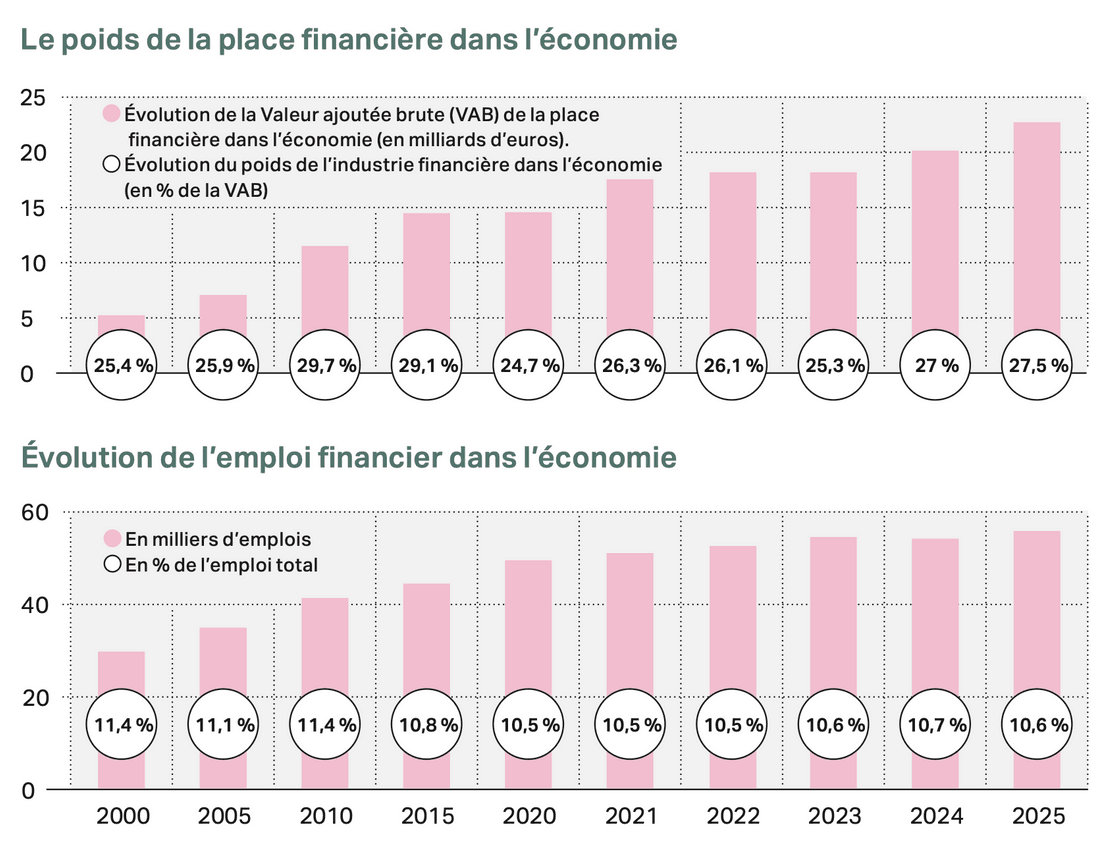
The significance of the financial centre and trends in employment within the financial sector. (Infographic: Paperjam; source: Statec, annual national accounts, series published on 6 March 2026)
The key figure
8,300. According to Luxembourg for Finance, this is the total value, in billions, of assets under management in Luxembourg funds by the end of 2025, of which €3,100bn is in alternative funds. This represents an overall increase of 50% over five years.
2. What two years of reforms have changed
The financial centre is changing its rules, but not yet its business model. Over the past two years, the Frieden government has, above all, overhauled the toolkit designed to boost the financial centre’s appeal. Since January 2025, the local authority income tax rate has fallen by one percentage point, whilst actively managed ETFs are exempt from subscription tax. Reform of the impatriate tax scheme, which allows half of annual remuneration up to €400,000 to be exempt from tax, and the relaxation of the profit-sharing bonus rules should also make it easier to recruit and retain specialist staff.
At the same time, the government has sought to better position Luxembourg in high value-added sectors. A new carried interest regime was introduced to attract more alternative fund managers and, with them, some of the decision-making centres currently based in London, Paris or southern Europe. The tax treatment of share options and the tax credit for business angels complement this strategy, but these measures are still too recent for their ability to shift business activities to Luxembourg on a lasting basis to be assessed.
The second focus of the review is technology. The Blockchain Law IV has secured the tokenisation of financial instruments, whilst the implementation of the European Mica Regulation has established a framework for crypto-asset stakeholders. In June 2025, the government itself tested this environment by issuing €50m worth of digital treasury certificates on a platform based in Luxembourg. The launch of the Peak Accelerator, the creation of an experimentation centre dedicated to artificial intelligence (AI) within the Lhoft, and the establishment of an advisory board on AI further demonstrate this commitment to using innovation as a key selling point.
The overall picture, however, remains mixed. The government has introduced a series of fiscal, legislative and technological measures, but it is still difficult to isolate their impact on business establishment, skilled employment or tax revenue. Assets under management are growing and alternative funds are gaining ground, though this has not yet been accompanied by a corresponding shift in management and decision-making functions. After two years, the regulatory framework has changed. As for moving upmarket, this remains to be seen.
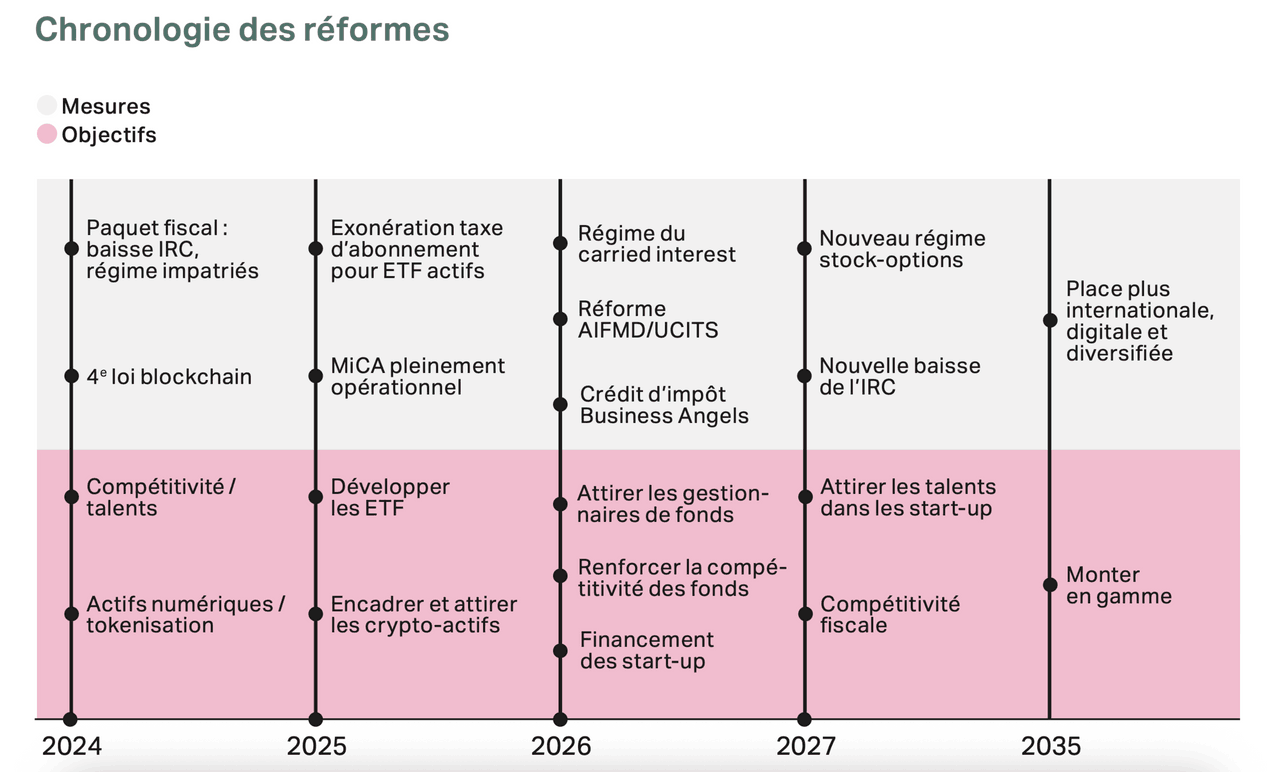
Timeline of the reforms. (Visual: Paperjam)
The key figure
€50m. This is the amount of the first issue of digital treasury bills carried out by the government in June 2025. Luxembourg has not only adapted its legal framework to blockchain technology, but has also used it itself. On 16 September, the minister for Finance, 
3. What battles must the financial centre win to remain a key player?
The five battles that will decide the future of the financial centre. The financial centre has no shortage of assets under management or international recognition. Its main challenge now is to transform this strength into greater value creation in Luxembourg. To achieve this, it will have to win five battles that go beyond the mere issue of its tax attractiveness.
The first will be that of decision-making centres. The growth of private equity and private debt is boosting the volume of assets domiciled in the Grand Duchy, but does not guarantee that fund managers, analysts and investment committees will set up operations there. The reform of carried interest should help to attract these strategic functions. Its effectiveness will be measured less by the number of new funds than by the number of teams actually based in the country.
The second battle will be a technological one. With four blockchain laws, a regulatory framework for crypto-assets and several tokenisation initiatives, Luxembourg has laid the groundwork. It must now move from pilot projects to solutions deployed on a large scale. AI raises the same question: will it become an industrial advantage in compliance, risk management and fund administration, or will it remain a series of experiments?
The third area concerns private markets. Private equity, debt, infrastructure and Eltifs represent the most obvious source of growth. However, competition is intensifying between London, Dublin, Paris and the financial centres of southern Europe. Luxembourg will need to demonstrate that it can accommodate the entire value chain.
A fourth battle will be fought in Brussels. The Savings and Investment Union (SIU), regulatory simplification and plans to centralise supervision may strengthen European markets, but could also erode some of Luxembourg’s advantages. The country will need to defend its expertise.
Finally, the financial centre will have to choose its next areas of specialisation. Sustainable finance, digital assets, insurance, payments and pan-European savings products all offer a range of possibilities. Having expanded its range of tools, Luxembourg will need to focus its resources on those sectors in which it can build a sustainable lead.
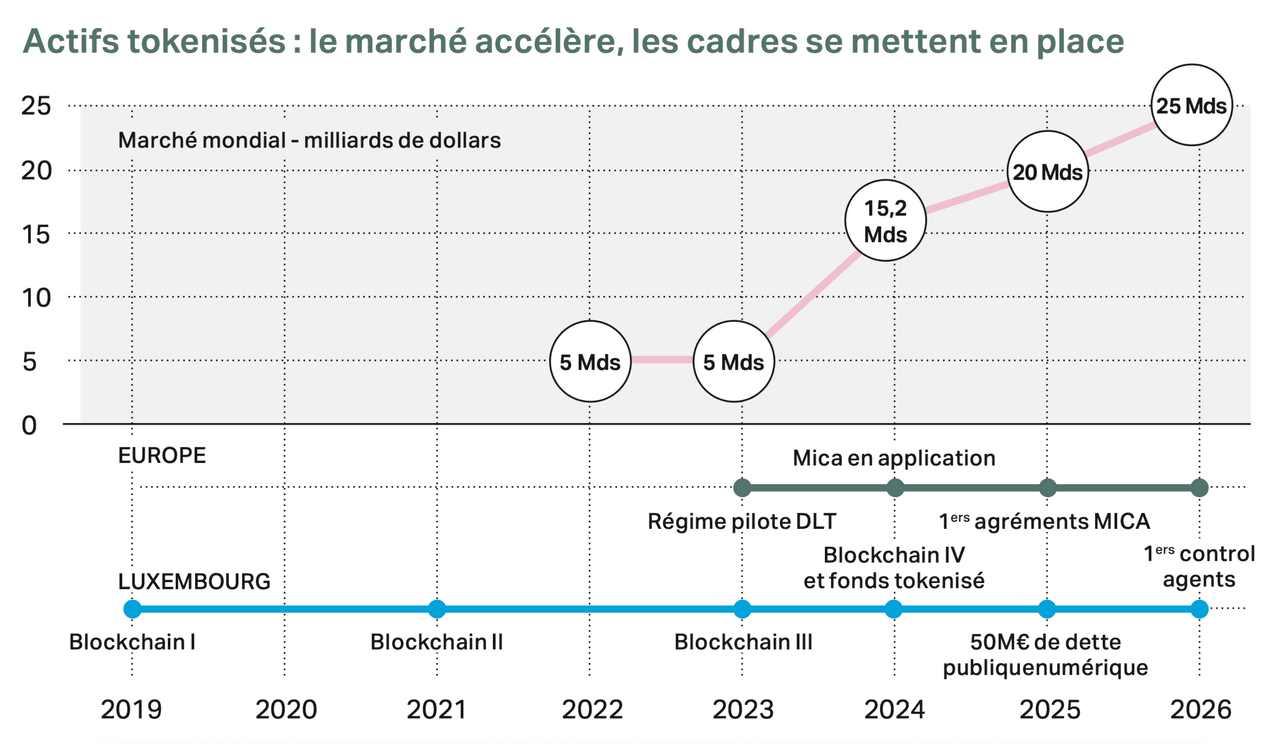
Tokenised assets: the market is gaining momentum, and the regulatory framework is taking shape. (Infographic: Paperjam; sources: RWA.xyz and DCM Core Institute. Estimated global figures; the scope may vary depending on the source.)
The key figure
1/3. Such as the proportion of assets under management in Luxembourg that are held in alternative funds. This figure illustrates the shift that is already underway towards private equity, private debt and infrastructure.
4. What further reforms could enhance the financial centre’s appeal?
The financial centre is still awaiting its latest round of reforms. After two years spent restoring the financial centre’s competitiveness, the government is keen to push through a number of further reforms. However, whether these are adopted before the end of 2026 remains dependent on the pace of parliamentary proceedings and the opinions of the Council of State. Four key areas will shape the next stage.
The most significant aspect concerns economic justice. The bill provides for the establishment of specialised commercial and criminal divisions within the courts and the Court of Appeal. Nine additional judges’ posts, ongoing training in financial law and the option to submit documents in English are intended to speed up the processing of complex cases. However, the bill is already raising concerns about the recruitment of the necessary candidates and the risk of a two-tier justice system.
On the talent front, the government is now focusing on share options. The scheme for innovative start-ups would defer taxation until the shares are sold, rather than at the time the option is granted or exercised. Applicable to options granted from 2027 onwards, it is intended to help start-ups and scale-ups attract talent that they cannot retain through salary alone.
Two more technical pieces of legislation complete the package. One transposes the European “Listing Act” in order to relax the rules on access to capital markets, particularly for SMEs. The other would allow the payment of the minimum share capital of a limited liability company (sàrl) to be deferred for up to 12 months, to prevent the sometimes slow process of opening a bank account from holding up its incorporation.
The major tax reform, however, lies further ahead. The introduction of the single tax bracket is scheduled for the 2028 tax year. It is intended to modernise household taxation and enhance the country’s appeal to international talent. Its success will also depend on the digital transformation of the Direct Tax Administration (ACD), which is set to run until 2030.
These texts share the same aim: to shift the focus towards activities with higher added value. But between announcements, votes and their actual implementation, the race against time is far from won.
The key figure
9. This is the number of additional magistrate posts planned to strengthen the economic and financial justice system.

“A public and political debate involving Parliament would be a good thing in Luxembourg,” says Sam Tanson, an MP for déi Gréng. (Photo: Guy Wolff/archive)
Sam Tanson’s view
According to the déi Gréng MP, the financial centre must adopt a ten-year strategy, accompanied by measurable targets and regular reviews before Parliament. Whilst not denying the value of the existing roadmaps or the minister’s commitment, 
She advocates three priorities: developing sustainable finance to fund the transformation of the European economy, safeguarding jobs in the face of AI, and ensuring the sector sets an exemplary standard in terms of integrity. Growth in the sector must not be an end in itself, but must serve the economy. Refusing to pit ethics against competitiveness, she regards reputation and the quality of supervision as assets for attracting capital.
This article was written for the November 2026 issue of Paperjam magazine, published on 14 October. The content is produced exclusively for the magazine. It is published on the website to contribute to Paperjam’s comprehensive archive. Click on this link to subscribe to the magazine.
Is your company a member of the Paperjam Club? You can apply for a subscription in your name. Please let us know via [email protected].